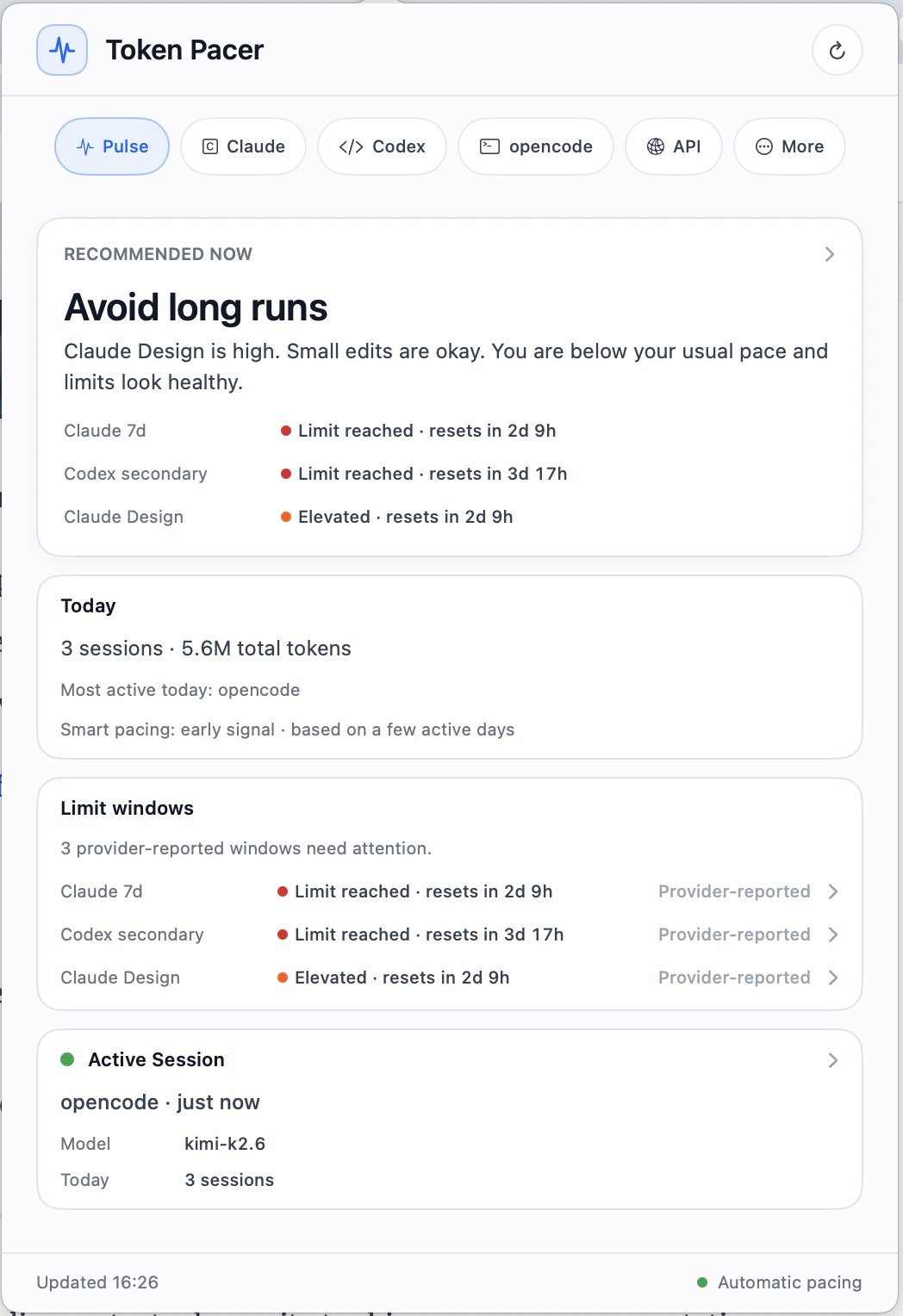
Track your AI coding agent usage and know what to do next — before you hit limits or overspend.
The problem
One more prompt. One more refactor. One more model switch. Then suddenly you hit a limit, burn API credits, or realize a single session consumed more than expected.
A long coding session pushes Claude or Codex closer to a rolling limit window.
API-backed agents add cost in the background while you stay in flow.
One refactor or autonomous run consumes more tokens than the rest of the day.
Know whether to wait, switch agents, or continue lightly.
The promise
Three signals, one decision. Token Pacer turns scattered logs and provider windows into a calm, single-screen answer to the only question that matters.
01
See what is happening now.
02
Know when quota windows or API budgets are getting tight.
03
Decide whether to keep going, switch agents, slow down, or wait.
Feature 01 — Best Next Action
The main tab turns scattered usage signals into a clear recommendation: keep going, switch agents, use API fallback lightly, wait for reset, or avoid long runs.
Feature 02 — Limit Windows
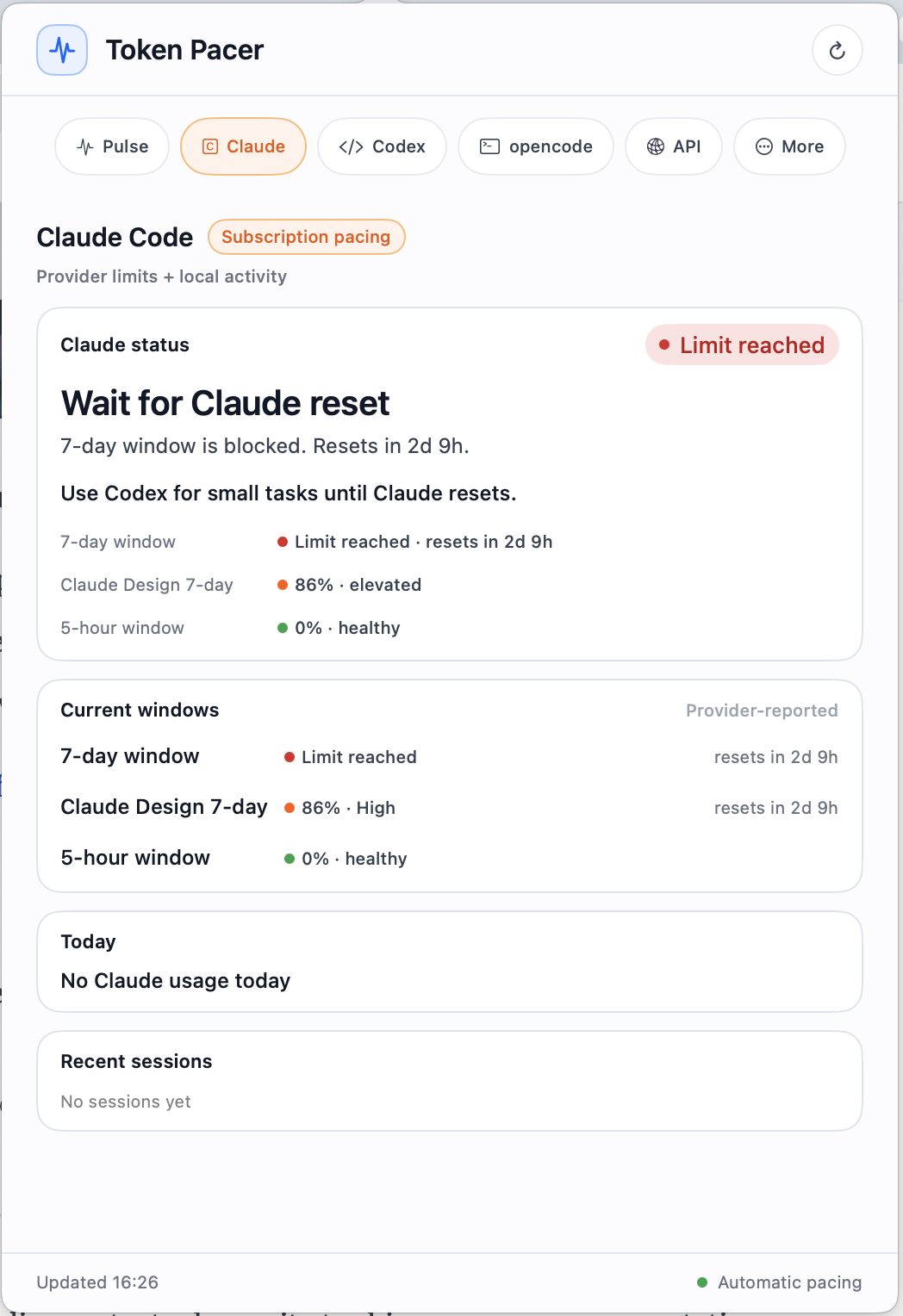
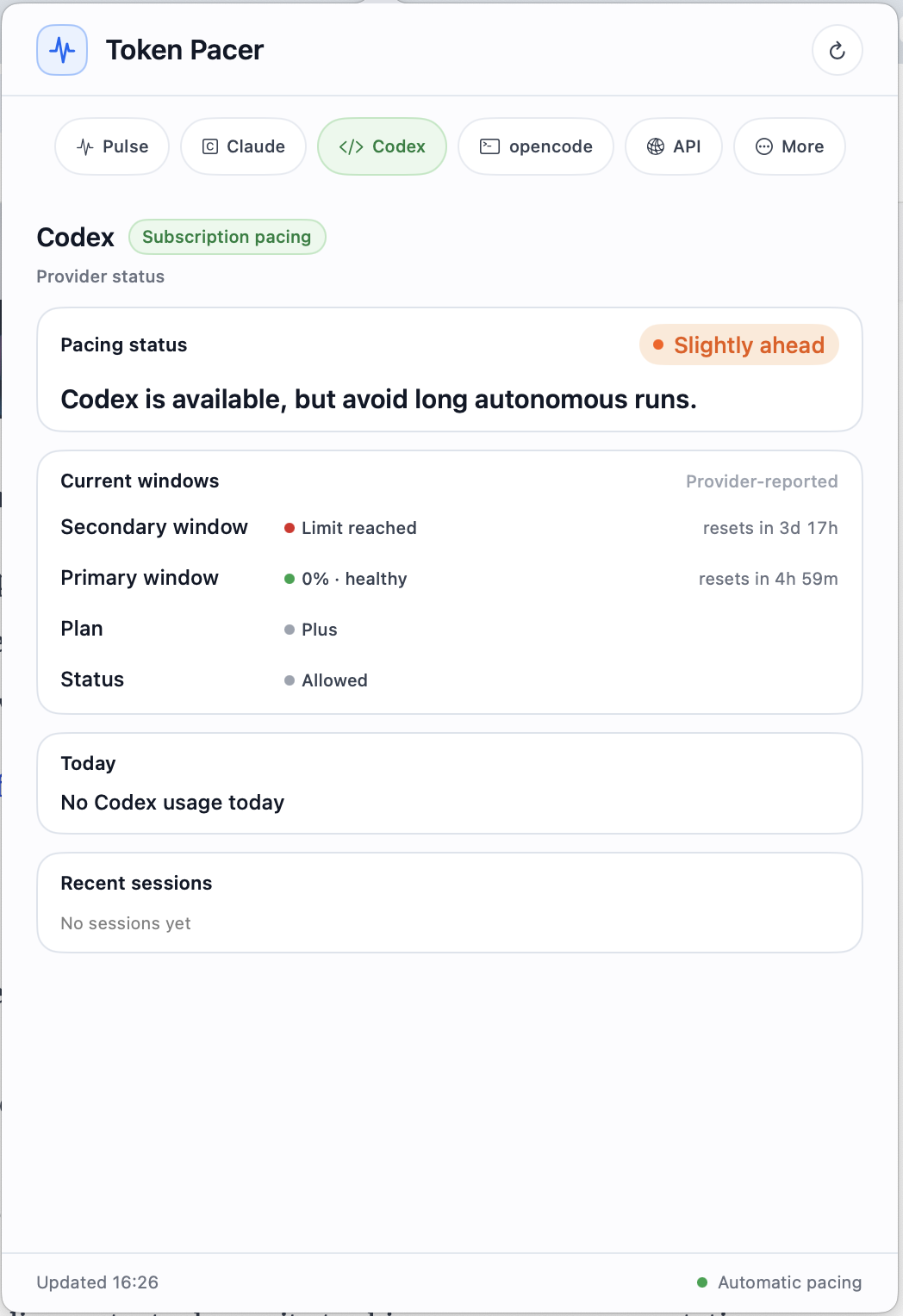
Track Claude, Codex, and provider-native windows with reset timing and pressure clearly labeled. Use provider-native signals where available — local estimates only when needed, and always labeled as such.
Feature 03 — Weekly Runway
Token Pacer projects whether your current usage is sustainable across API spend and subscription limit windows — so Friday doesn't surprise you on Tuesday afternoon.
Feature 04 — Recent Sessions
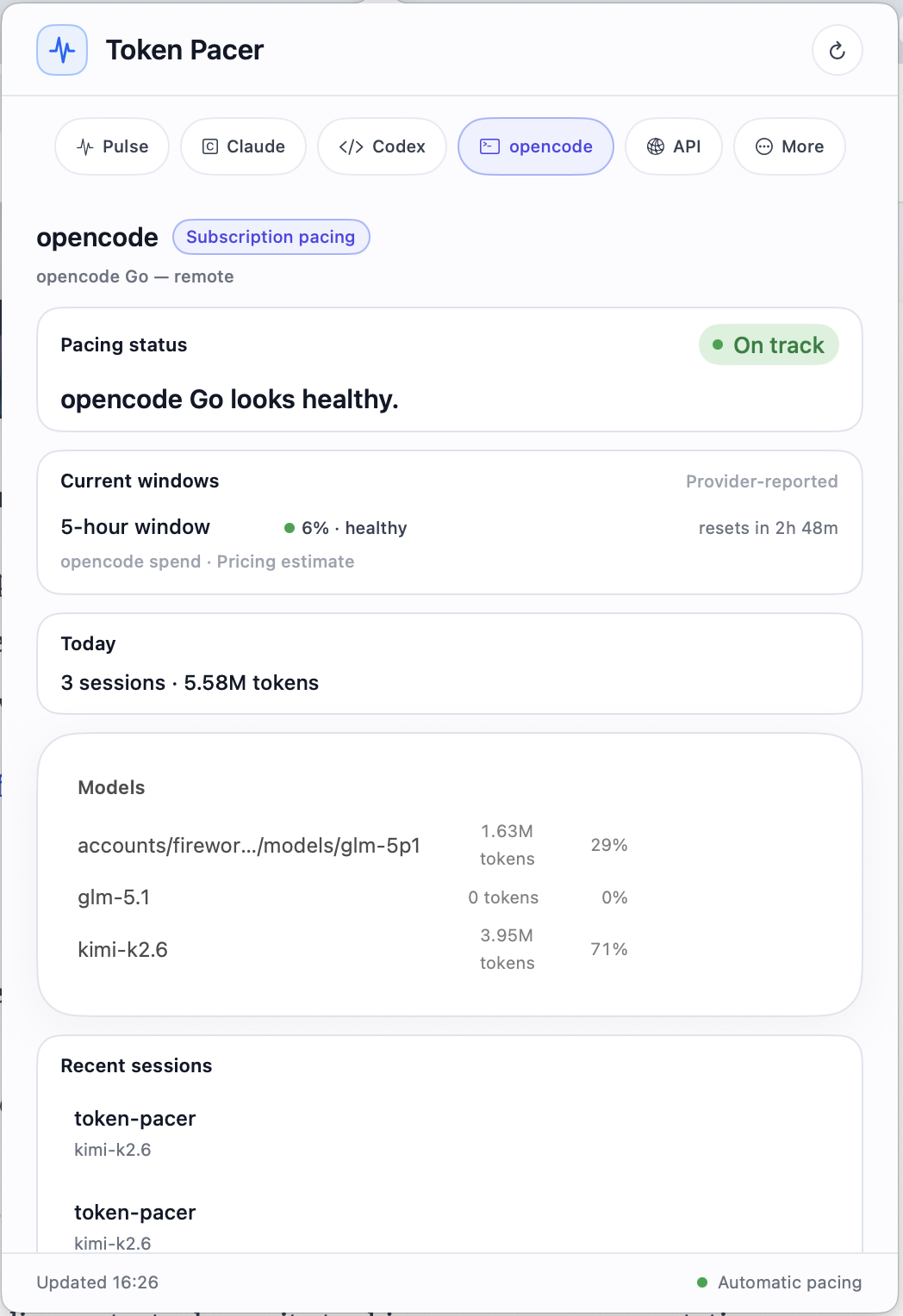
See recent agent sessions, models, projects, turns, and usage — so a long-running session doesn't stay invisible until the bill arrives or the limit lands.
Local-first
Token Pacer reads supported local agent logs and turns them into useful pacing signals. No account, no cloud sync, no telemetry, and no prompt or code uploads.
Token Pacer watches supported local agent logs, normalizes them into usage events, and builds pacing views entirely on your Mac.
Claude Code logs local Codex logs local opencode logs local Supported agents
Pace across the agents you actually use today, with a clear roadmap for adding more as reliable local signals become available.
Subscription windows, usage pressure, reset timing, and local session activity. Provider-native limit windows where available.
Usage windows, session activity, plan pressure, and primary/secondary window tracking where the provider exposes it.
API spend, token usage, model costs, and budget pacing across API-backed agents and inference providers.
Supports Claude Code, Codex, and opencode first. More agents will be added as reliable local signals become available.
How it works
Three steps from disk to decision — same architecture, whether you use one agent or four.
Token Pacer monitors agent logs already on your Mac — Claude Code, Codex, opencode — without ever sending them off-device.
Each event is the source of truth. Sessions, projects, model splits, and rollups are derived from local usage data.
Today's activity, limit windows, weekly runway, and the best next action — labeled by source and ready to act on.
Source of truth: Usage events are the lowest-level record. Sessions, projects, and rollups are all derived from local usage data — so when something looks off, you can trace it back to a single event in a single log file.
Made for flow
Token Pacer lives in your menu bar, but it does not ask you to babysit another dashboard.
A quiet heads-up when limits, runway, or API spend actually need attention — not for every blip.
Open your current pace instantly — check, decide, get back to coding without breaking flow.
⌥⌘PA small glyph and a single number. Click for the full picture; otherwise it stays out of the way.
Pricing
Free to download. Upgrade when Token Pacer works for your workflow.
Token Pacer License
One developer, up to 3 Macs. Includes all 1.x updates.
Try Token Pacer on your Mac first.
Regular price may increase to $49 after early launch.
FAQ
Download Token Pacer and see your agent usage before it becomes a surprise.